
A practical guide to AI workflows, creator strategy, measurement and the relationships that make the next campaign easier to build.
An AI shortlist can arrive before your coffee. You still have to explain why those creators fit the brief, negotiate what happens to their content and answer finance when the sales report looks suspiciously generous.
In IAB’s 2025 survey of 453 US creator advertising buyers, 46% were already using AI and another 29% planned to start within 12 months. Separately, 95% expressed concerns about AI in creator marketing. Adoption and doubt were happening together. Read the IAB research.
- 46%of US creator advertising buyers were already using AI (IAB, 2025)
- 29%planned to start using AI within 12 months
- 95%expressed concerns about AI in creator marketing

Show data
Share of respondents | |
|---|---|
Currently used AI | 46 |
Planned use within 12 months | 29 |
Interested | 17 |
No plans | 8 |
The survey covers U.S. brands and agencies planning at least $1 million in advertising and $100,000 in creator marketing spend in 2025. Adoption plans and concerns are separate questions. IAB research.
What the job needs in 2027
The pressure on an influencer marketing manager comes from several directions at once. Your team wants more output. Creators want clear decisions and room to make work their audiences will watch. Finance wants a defensible account of what the budget bought. AI can help with the workload, but someone still has to connect those demands.
Our recommendation for 2027 is to develop the skills around the campaign decisions you own. Learn how to evaluate an AI-generated shortlist, price a usable content package, design a measurement plan and keep a creator relationship alive between briefs. Those capabilities remain useful when the software changes.
AI fluency includes verification. Count correction time and missed facts when judging an automated workflow.
Creative judgment needs evidence. Use audience questions, creator experience and observed content performance to shape the brief.
Commercial confidence comes from clear definitions. Agree on rights, costs, attribution and the test before content goes live.
Relationships need follow-through. Give IRL gatherings a purpose and make someone responsible for the next conversation.
The evidence comes from consulting research, agency practice, industry studies and official product documentation available by November 5, 2026. The 2027 recommendations are NeoReach’s interpretation. Survey findings retain their original dates and populations. Tool examples reflect documented capabilities.
Work that demonstrates each skill
Skill | What your team should be able to inspect |
|---|---|
AI evaluation | A checked workflow with known errors and review time |
Creator selection | A recommendation supported by audience and content evidence |
Creative briefing | A testable idea tied to a consumer question |
Commercial negotiation | An agreed scope and rights schedule for each asset |
Measurement | A reconciled report with clear cost and attribution rules |
Internal collaboration | A test plan agreed with media, analytics and finance |
Creator relationships | A maintained record of commitments and follow-up |
IRL production | A purposeful event with documented next steps |
NeoReach recommended work products for development and team review.
Use AI with an acceptance test
The useful AI skill is being able to describe a job precisely enough to check the result. “Find me great creators” leaves almost every important decision unstated. A better task specifies the market, audience, product experience, permitted sources and the evidence required for each recommendation.
McKinsey’s 2026 survey found that 80% of respondents reported improved individual productivity from AI, 50% reported better decisions and 37% attributed some enterprise EBIT impact to it. These were different questions in a cross-industry survey of 1,719 people. Faster work and commercial value need their own measures. Read McKinsey’s study.
Show data
Share of respondents | |
|---|---|
Improved individual productivity | 80 |
Better decisions | 50 |
Some enterprise EBIT impact | 37 |
Individual benefits and enterprise earnings are distinct measures. The multi-industry survey covered 1,719 respondents in 97 countries during May-June 2026. McKinsey State of AI.
Start with a bounded task your team understands. Extract deliverables and usage dates from an approved brief. Cluster audience questions from an authorized set of comments. Draft a report using supplied campaign exports. Require the output to point back to the source and leave missing information blank. A confident guess about an exclusivity clause can become an expensive calendar invite.
Test the workflow on completed briefs whose answers you already know. Count incorrect fields, missing conditions and unsupported claims, then include the reviewer’s time in the productivity calculation. Recheck it after changing the model, prompt or source format. Keep the accepted version and the reviewer alongside the output so colleagues know which draft they can use.
Career anxiety deserves a practical response. Build a small portfolio showing an original workflow, the automated version, the errors caught and the resulting change in delivery time or quality. This gives your manager evidence for expanding your responsibility. A collection of prompt certificates says much less about how you handle a real campaign.
Put the human review where mistakes matter
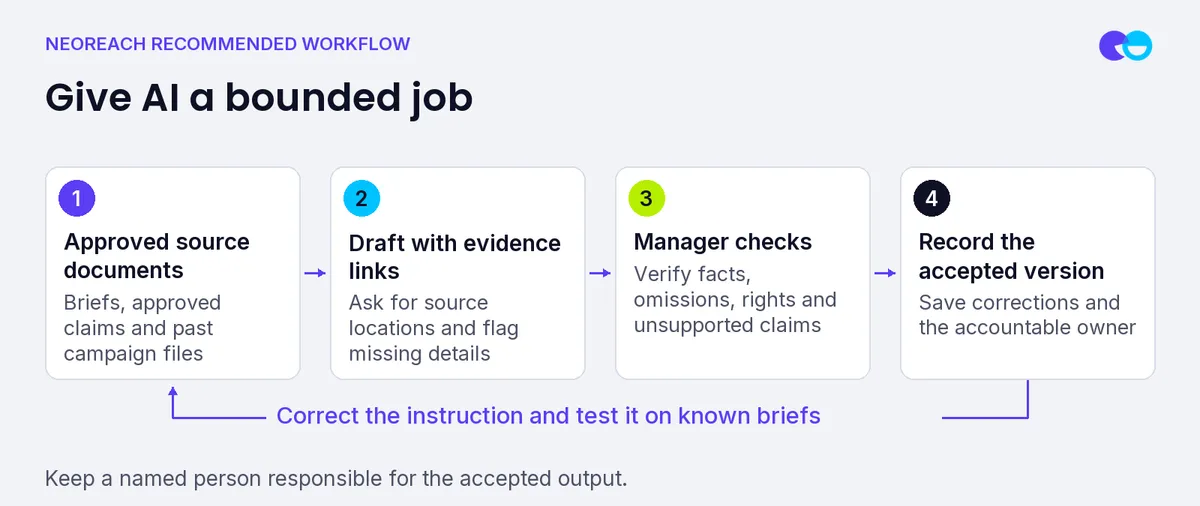
NeoReach’s recommended workflow for AI-assisted campaign work. A named manager checks the evidence and accepts the final version.
Use the AI environment your organization has approved for the information involved. Access to a tool does not settle whether a particular contract, customer export or unreleased product plan belongs in it. Set the allowed inputs, output destination and reviewer before the workflow becomes part of campaign delivery.
Keep commitments under a named owner. Creator outreach, negotiated fees, contract changes and publication require the appropriate person to review what will actually be sent or approved. Automation can prepare the work and route it. The person handling the relationship needs to understand the promise being made.
For a useful pilot, choose one recurring task with enough volume to compare. Record elapsed time, review time and the number of material corrections for the existing process and the trial. A small improvement that survives review is worth more than an impressive demo that quietly gives the account manager a second job.
Find creators who can change a decision
Start casting with the consumer problem. Are people unaware of the product, unconvinced by its claims, confused about how to use it or reluctant to pay the price? Each barrier calls for different experience and content. “Tech creator” is a search category. “Can explain why this laptop suits a first-year engineering student” is a casting requirement.
In Deloitte Digital’s 2025 consumer research, 83% of respondents regarded the creators they followed as trusted information sources. The sample comprised 1,000 US adults who used social media and had recently bought online, with younger consumers overrepresented. That finding makes relevance worth investigating. It does not tell you which creator your buyer trusts.
- 83%regarded the creators they followed as trusted information sources (Deloitte Digital, 2025)
- 1,000US adults who used social media and had recently bought online
Review the work behind the profile. Look for repeated category coverage, substantive audience questions, credible firsthand use and how the creator handles corrections. Check audience geography and likely buyer fit. Keep vendor-estimated demographics separate from creator-provided analytics and what you have directly observed.
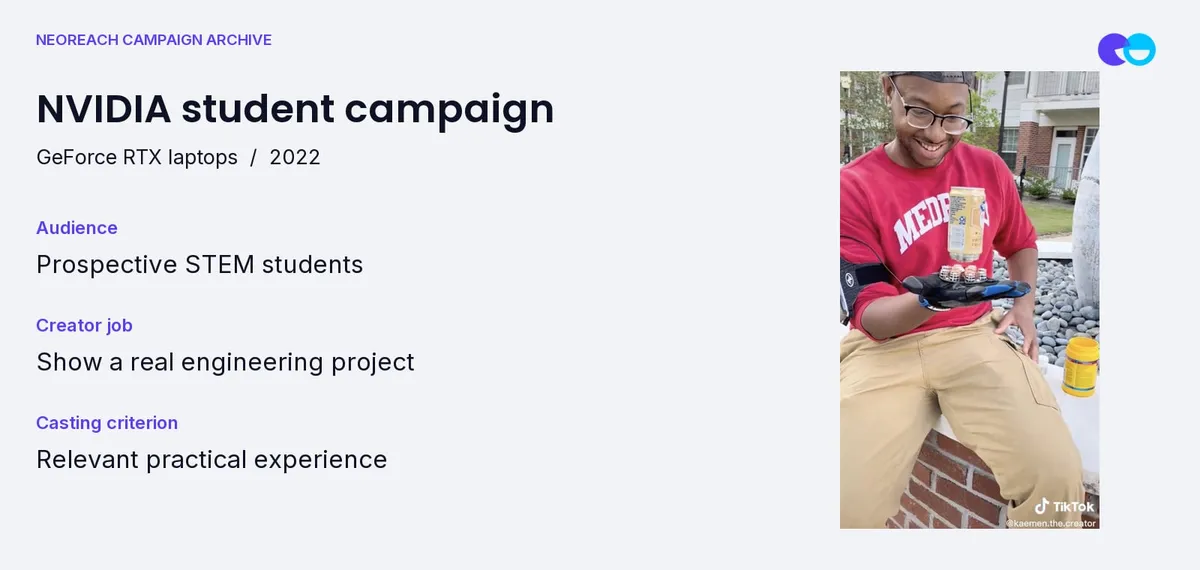
NeoReach’s 2022 NVIDIA campaign recruited four creators to demonstrate GeForce RTX laptops to prospective STEM students. Kaemen Lafleur’s glove project gave the product a place inside an engineering story. The useful casting lesson is specific expertise that can make a demonstration interesting. The campaign’s reach does not establish an incremental sales effect. Explore the NVIDIA campaign.
Ask shortlisted creators how they would explain the product and which audience objection they expect. Their answer can expose a weak fit before the contract does. Save the evidence for the selection, including why you declined an apparently impressive profile. Next quarter’s team should be able to understand the choice.
Turn audience insight into a better brief
A useful listening habit starts with the language consumers use when they are trying to decide. Search for comparisons, workarounds, complaints, questions about price and situations where the product disappoints. Group recurring questions, then read the original posts. A sentiment score can flatten sarcasm, context and a surprisingly affectionate complaint into the same red cell.
VaynerX and Ipsos found that 84% of 100 US marketers agreed organic social could help identify content worth scaling to other platforms. Only 47% said they designed campaigns around how they would live on social channels first. These are reported beliefs and practices, not measured campaign effects. Read the VaynerX and Ipsos findings.
Show data
Share of marketers | |
|---|---|
Agree organic social helps identify winning content to scale to other platforms | 84 |
Design campaigns around social channels first | 47 |
Different statements from a survey of 100 US marketers. Agreement about a channel’s value does not show how a campaign performed. VaynerX and Ipsos research.
Translate a real audience question into a creative test. Suppose people worry that a portable projector will be useless in a bright room. Brief a creator to show the same scene under clearly described lighting conditions. Keep the test honest, show the limitation and give the viewer enough context to decide whether it suits their home.
The brief should identify the audience problem, product evidence, required disclosure and desired next action. Give the creator room to choose the story. Agree on what can vary between versions, such as the opening question or demonstration order, so results can teach you something. Changing the creator, offer, audience and landing page simultaneously makes interpretation harder.
Before scaling content, check whether its results came from organic distribution, paid support or both. A post with a large promoted total is a poor organic benchmark. Use early responses to refine a hypothesis, then test it with the media team under reasonably comparable conditions. One viral outlier is a wonderful surprise and a terrible annual operating plan.
Negotiate the content you actually need
A creator fee becomes meaningful when the scope is clear. Separate production, publishing, paid usage, exclusivity, additional edits, travel and event participation. Specify the channels, territories, dates and versions you expect to use. The cheapest quote can become the expensive option when the winning video needs a second negotiation before media can run it.
Build the commercial brief with paid media before outreach. A request for a creator post and a request for six ad variations create different workloads and permissions. Define who supplies cutdowns, who approves them, how long advertising can run and what happens when the permission expires. Keep the signed agreement linked to each asset.
Platform authorization needs its own check. TikTok Spark Ads can promote an authorized creator post, and engagement from that promotion is credited to the underlying post. Check the platform authorization period against the rights you negotiated, and preserve paid reporting when evaluating performance.
AI makes the scope discussion more specific. Ask whether the brand intends to translate a creator’s voice, generate new performances or alter their likeness. Put those proposed uses through an explicit negotiation and review process. An October 2026 Ogilvy panel with talent representatives emphasized consent, usage terms and talent sign-off for synthetic content.
Plan disclosure during briefing and check the actual execution. US FTC guidance covers material connections including payment and free products, and calls for disclosures where people will notice them. A gifted event experience can therefore need the same attention as a paid post. Confirm the rules for the markets and channels in the brief with your legal team.
Track the cost of the usable campaign. Include production, rights, paid distribution, logistics and management where relevant, and state which costs your efficiency metric includes. A media-only ROAS and a full-program return calculation answer different budget questions. Agree on the one you need before someone starts decorating the slide.
Agree who can pause paid distribution, who contacts the creator and who approves a response if a product claim is challenged or an asset runs beyond its agreed usage period. Put those names in the campaign plan before launch.
Separate attribution from incremental impact
Measurement literacy starts with four different questions. Did content reach the intended audience? Did people engage or take a useful next step? Which sales received credit under the attribution rules? How much additional business happened because of the intervention? Keep the answers separate enough to make a budget decision.
IAB’s January 2026 measurement assessment describes fragmented data across native platforms, creator reports, commerce systems and studies. It also identifies inconsistent definitions and limitations in earned media value. An influencer manager needs to reconcile these records before a polished dashboard can be trusted.
What each measurement can tell you
Evidence | Question it answers | Important limit |
|---|---|---|
Delivery and engagement | Who could have seen the content and how people interacted | Views and impressions are not deduplicated people |
Linked behavior | Which tracked visits or actions followed a link | Misses untracked journeys and other exposures |
Attributed sales | Which purchases receive credit under a stated rule | Credit does not establish additional sales |
Incremental lift | How outcomes differ under a credible comparison design | Depends on study design, volume and uncertainty |
NeoReach measurement guide. Match the evidence to the question before choosing the metric.
Consider an illustrative campaign with $20,000 in creator and production costs, $10,000 in paid distribution and $60,000 in attributed revenue. Using total campaign cost gives attributed ROAS of 2.0. Using only media spend gives 6.0. Neither figure tells you the revenue that would have happened without the campaign, and neither accounts for product margin.
Work with analytics to define the primary outcome, attribution window, new-customer rule and cost scope. Test links, conversion events and redirects before launch. Reconcile refunds and cancellations where they affect the result. For a lift study, agree on the treatment, comparison group and test window before buying the activity.
Google Ads Conversion Lift illustrates a controlled treatment-and-comparison approach for eligible advertising campaigns. Availability and sample requirements matter, and the result concerns the activity being tested. A paid creator-ad experiment does not automatically isolate every effect of the wider organic program.
When the program is too small for a useful lift estimate, say what the evidence can support and plan the next test. Showing the limits of an attribution report is part of managing the investment. It gives the team a sensible reason to fund better measurement.
Bring finance and media into the test plan
You need enough analytical fluency to ask good questions and enough internal influence to get answers before launch. That includes the ability to explain a test to finance, translate a creative hypothesis for paid media and agree on an outcome with ecommerce. These are working relationships that affect what you can learn from the campaign.
In BCG and Google’s Q1 2025 research, 61% of measurement leaders involved cross-functional leaders in learning agendas and reviews of experiment outcomes, compared with 19% of other respondents. The survey covered 3,140 senior marketing analytics professionals. The comparison is observational, and the leader classification partly includes financial performance.
Show data
Involved cross-functional leaders | |
|---|---|
Measurement leaders | 61 |
Other respondents | 19 |
Leaders were classified partly by standardized KPIs, advanced measurement and strong EBITDA performance. The comparison is observational. BCG and Google measurement research.
Write a short test brief before the kickoff. State the decision the result will inform, the audience, the intervention, the main outcome and the conditions that would make the result hard to interpret. Get agreement on the minimum evidence needed to repeat, revise or stop the activity.
For example, a creator demo may be designed to reduce uncertainty among product-page visitors. The media team can help define delivery. Ecommerce can report the relevant conversion behavior. Finance can agree how to account for cost and margin. You can own the creative question and the creator relationship while specialists own the parts they are equipped to evaluate.
Put decisions in the meeting record. “Promising engagement” is unlikely to settle the next budget request. “Repeat the demo with the same offer and a planned comparison group because the first test could not separate creative from audience changes” gives the team a specific next move.
Build creator relationships between campaigns
CreatorIQ and Influencers.club’s 2026 survey of 5,095 creators across 100 regions found that 42% reported tension between the content their audiences wanted and what brands requested. It is a useful reminder that the person taking your brief has another constituency to serve.
- 42%of creators reported tension between what their audiences wanted and what brands requested
- 5,095creators surveyed across 100 regions (CreatorIQ and Influencers.club, 2026)
A strong relationship gives you earlier access to that judgment. Invite creators to explain what their audience is asking, what they would refuse to claim and which collaboration formats interest them. Pay for substantive creative development or consulting work. Asking for three fully developed concepts before discussing a fee is an oddly efficient way to learn less about a creator.
Maintain a professional relationship record with an owner, relevant interests, previous work, feedback, commitments and a next-contact date. Include payment status and agreed rights so the next colleague does not reopen a settled issue. Record what the creator chose to share for the collaboration. Keep personal gossip out of the database.
After a campaign, share useful results and explain what changed because of their input. Follow up when you have something relevant, such as access to a product specialist, an answer to feedback or a paid opportunity. Use the relationship record to deliver something the creator actually asked for.
This is where a relationship moat can develop. Repeated collaboration can accumulate knowledge of the product, the audience and how both teams work. Reliable payment and fulfilled promises give a creator reasons to answer the next call. That advantage takes maintenance and does not confer ownership or guaranteed exclusivity.
Measure the work that makes the relationship dependable. Track payment timeliness, completed commitments, accepted repeat offers and creator feedback over a defined period. Review why partnerships end. Retention is useful context, but a creator staying on the roster does not by itself prove better campaign economics.
Give IRL events a useful job
A creator dinner needs a reason to exist beyond a group photo. Product learning, peer exchange, community participation and honest feedback are all possible jobs. Choose the one that fits the people invited, then design the room around it. A product engineer who answers difficult questions can be more useful than another backdrop with the campaign hashtag.
Ogilvy’s 2026 influence report describes Creator Camps launched in 2025. In one example, Cadbury Dairy Milk brought 30 creators together in Pakistan for program onboarding. The operational lesson is that an event can sit inside a longer partnership program. The report does not establish the sales return from that gathering.
Show data
Share of respondents | |
|---|---|
Socializing matters but should not be the focus | 58 |
Want control over how and when they interact | 45 |
Want space to sit back and observe | 41 |
Self-reported preferences from 4,051 US and UK respondents aged 18-35, surveyed July 11-16, 2025. These measures are separate and do not sum to 100%.
Eventbrite’s 2026 study found that 58% wanted socializing without making it the event’s focus. Its July 2025 survey covered 4,051 people aged 18–35 in the US and UK. These preferences can inform event design.
For a small creator workshop, ask participants about the product questions they want answered before setting the agenda. Combine a shared activity with optional conversation. Offer somewhere to observe, accessible participation and enough unstructured time to speak. Brief hosts to make useful introductions without treating every guest as a content-production station.
Separate the invited experience from contracted deliverables. If you require a post, a recorded interview or consultation, agree on it and compensate the work. Confirm filming permissions, travel arrangements and the approval route in advance. Creators should be able to understand what accepting the invitation commits them to.
Make the next conversation part of the event plan
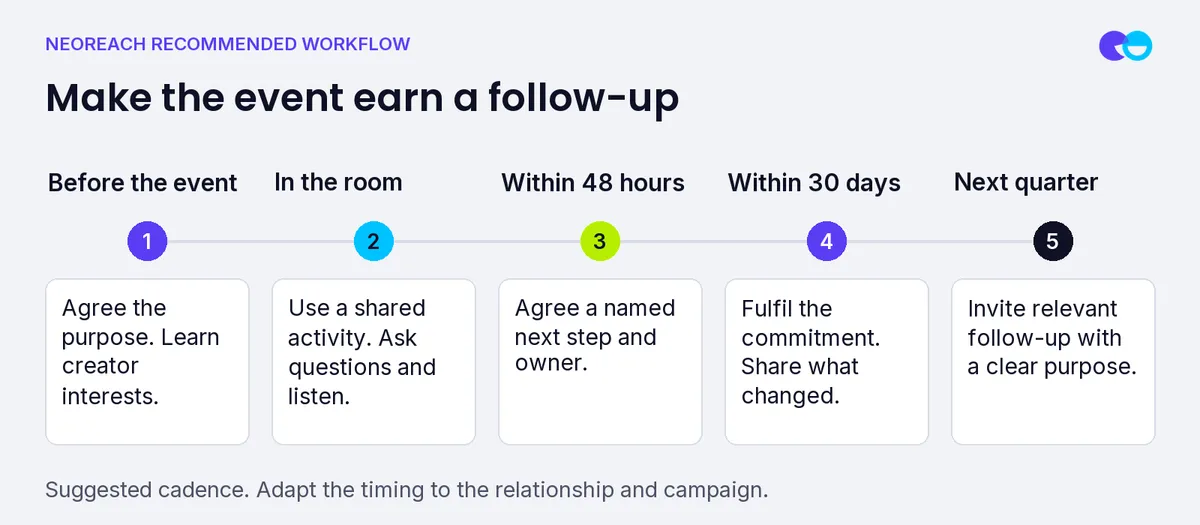
NeoReach’s recommended event follow-up workflow. The timing is an illustrative planning cadence, not a research benchmark.
Before the event, assign a relationship owner and decide what useful follow-up could look like. During it, capture questions and commitments with permission. Within two days, send the promised resource or confirm who will provide it. Over the following month, close the loop on feedback. These timings are suggested operating targets that your team can adapt.
Build the next gathering around what participants learned or asked for. If a group wants to understand product testing, arrange access to the people who do it. If creators identify a repeated customer problem, tell them whether the product team changed anything. The relationship becomes more valuable when participation has a visible consequence.
NeoReach’s work at Sony CES 2023 illustrates a related production skill. Creators and an on-site crew produced short reports for Sony’s global accounts, including Denver McQuaid’s interview with Sony Honda Mobility’s Jun Koketsu about AFEELA. Access, informed questions and an edit route made the interaction usable as content. The case does not measure long-term relationship value.
Keep event reporting honest. Attendance divided by confirmed RSVPs tells you about turnout. Completed follow-ups divided by commitments tells you about delivery. Accepted repeat collaborations tell you something about continued interest. Track each over a stated window, and record reasons for decline where creators volunteer them.
To assess commercial value, add the relevant campaign evidence and a suitable comparison when possible. Invitees are often selected because they already like the brand, so their later purchases or posts cannot automatically be credited to the event. The useful question is which relationships and activities justify another investment, with the evidence you actually have.
Choose tools that fit the work
Start with your existing systems and identify the missing capability. Buying another dashboard will not fix inconsistent campaign names or an approval process that lives across six inboxes. The examples below have documented functions relevant to this job. Availability, integrations and enterprise controls need to be checked against your organization’s requirements.
Tools for research and creative work
Job | Tool example | Check before adopting |
|---|---|---|
AI-assisted review | Microsoft Copilot in an approved enterprise setup | Data permissions, plan controls and a human acceptance test |
Discovery and creator CRM | Modash for search, audience analytics and relationship records | Platform coverage and integration fit, particularly for its Shopify focus |
Audience listening | Sprout Social Listening for topics, sentiment and conversation analysis | Query exclusions, accessible data and inspection of original posts |
Creative review | Frame.io for anchored comments and review workflows | Named approvers, exact asset version and separate rights clearance |
Official product documentation checked November 5, 2026. Examples by task, not a comparative performance ranking.
Evaluate tools using a small sample of your own permitted work. Can the team retrieve the original evidence behind a creator recommendation? Can someone identify the approved asset without asking the account manager? Can you export the records if you change suppliers? Test the handoff between colleagues as well as the feature demo.
Tools for operations and measurement
Job | Tool example | Check before adopting |
|---|---|---|
Campaign records | Airtable for structured records and workflow automations | Record owners, access settings, automation limits and failed runs |
Linked traffic | GA4 and UTM tagging for campaign referral reporting | Naming consistency, tested events and attribution scope |
Controlled lift | Google Ads Conversion Lift for eligible ad experiments | Eligibility, volume, uncertainty and which activity the study isolates |
Event operations | Cvent OnArrival for check-in and attendance records | Fit to event size, attendee permissions and connection to follow-up records |
A small workshop may need only existing registration and CRM tools. A platform attendance record does not measure relationship quality.
Give each campaign, creator and asset a stable ID across the tools you use. Keep dates, currency, paid versus organic delivery and metric definitions in controlled fields. Store raw exports with the reporting window, then build the summary. Spreadsheet joins, pivots and reconciliation are valuable skills here. SQL becomes useful when the volume or warehouse warrants it.
Name the person responsible for maintaining each connection. Test how the system handles an expired usage date, a missing post ID, a revised invoice and an event guest who opts out of follow-up. These ordinary exceptions are where the real operating cost appears.
Build the skills on your next three campaigns
Choose a development plan that leaves behind work the team can reuse. Treat the following 90-day sequence as a suggested schedule, adjusted for your campaign cycle. Ask your manager for access to the people and data required, because improving measurement or production is rarely a solo assignment.
1. Audit one completed campaign. Reconcile the costs, links, content versions and rights. Identify the decision its report could not answer. Pilot one bounded AI task against known answers and record both review effort and errors.
2. Apply the findings to a live brief. Agree on the intended consumer change, creator-selection evidence and measurement plan with media and analytics. Negotiate the content package, then consolidate approvals in one documented workflow.
3. Run or improve a small creator gathering with a clear purpose. Complete the promised follow-ups. Review the campaign with the creator and internal partners, and decide which relationship, creative approach or test deserves another investment.
4. Judge the development plan by the work it changes. You should be able to show a checked AI workflow, a clearer brief, an agreed rights schedule, a reconciled campaign report and a relationship record someone else can use. Where a result remains uncertain, write down the next question and how you would investigate it.
Pick the weakest handoff in your current process and fix it on the next campaign. It may be the moment a shortlist becomes a recommendation, an approved video becomes a paid ad, or an event conversation becomes a promise. That is a practical place to build a skill your team will notice.