Choose the right creator strategy, turn product demonstrations into useful action, and decide what deserves more budget.
A creator makes your software look useful. Someone clicks, creates an account and meets a blank screen. The campaign has delivered interest. The product still has to deliver the moment that made them interested.
That handoff deserves more attention in your 2027 influencer strategy. For tech brands, creators can explain an unfamiliar product, demonstrate a difficult task and give people a reason to try. The stronger programs connect those jobs to something the audience can actually use: a template, a working example, a trial or a credible buying decision.
Influencer marketing for tech brands is the deliberate use of creator expertise and distribution to help an intended audience understand, evaluate or adopt a technology product. It can serve consumer hardware, AI applications, developer tools and enterprise software. Those products do not need the same campaign.
This guide combines company growth stories with NeoReach campaign records and practical planning models. Gamma, Notion and ElevenLabs provide useful operating lessons; NeoReach's NVIDIA, Agora, ViewSonic and Intuitive Machines work shows how different briefs become content. The models are recommendations, and the financial example is explicitly illustrative. The evidence was checked in October 2026 for 2027 planning.
Choose the buying obstacle before you choose the creator
“We need tech influencers” is a category request, not a strategy. A developer deciding whether an API fits their application has a different problem from a student comparing laptops. A productivity creator may be right for the second audience and completely wrong for the first.
Start with the unresolved question. Is the product's value hard to picture? Is it easy to admire but difficult to start using? Does adoption require technical confidence or approval from someone else? The answer changes the person you hire, the evidence they need and the destination you build.
Match the campaign to the obstacle
Buyer obstacle | Creator assignment | Useful next action |
|---|---|---|
I cannot picture the benefit. | Show a recognizable task and its finished result. | Try the same task or inspect the relevant product. |
I would not know where to start. | Teach a workflow and provide a reusable starting point. | Open the template and complete the first task. |
I doubt it will work in my situation. | Have a practitioner test the relevant requirements and limits. | Evaluate documentation, a sandbox or a suitable demo. |
I need others to understand it. | Explain the technical or organizational issue with evidence people can share. | Use the explanation in a team discussion or evaluation. |
A planning model for the brief. Several obstacles can coexist; choose the one this assignment will address.
Then check whether the creator can do the work. Ask them to describe the audience's problem and show a relevant example from their own content. Verify audience fit with available analytics and the questions people ask them. A technically fluent creator with the wrong audience still has the wrong audience.
This also separates three commercial arrangements. A commissioned demonstration buys defined work. An affiliate arrangement rewards eligible referrals. Community support helps existing users teach and advocate. You can combine them, but put the responsibilities, compensation and success measure in writing. Free access does not create an obligation to publish.
Gamma made product fluency part of creator onboarding
Gamma is a substantial growth story. In its November 2025 announcement, the company reported crossing $100 million in annual recurring revenue, with 70 million users. By October 2026, it said more than 100 million people had used Gamma. These are dated company-wide milestones, not an attribution report for influencer marketing.
- $100Mannual recurring revenue reported in the November 2025 announcement
- 70Musers reported at that announcement
- 100M+people had used Gamma by October 2026
The useful tactic is in founder Grant Lee's account of the early creator program. He personally called the initial influencers, showed them how Gamma worked and helped them understand its usefulness. He wanted them to explain it in their own voice. The process began with product understanding, before publication.
For an AI tool, that distinction matters. A creator can produce an attractive result by following a carefully prepared prompt. A prospective user still needs to understand the input, the edits and the conditions required to get something useful. If the only reproducible part of your demo is the excitement, the brief needs another pass.
Adapt Gamma's approach with a working session before concept approval. Have the creator complete a task their audience recognizes using the same access a new user will receive. Ask where they got stuck, what surprised them and what they would need to explain. Give them a product contact who can resolve errors without writing their personality out of the video.
The output of that session should be a concrete creative brief: the task, the result worth showing, the steps that matter and any limitation that could change the viewer's expectations. Let the creator choose the opening and delivery. Product fluency is a better foundation for creative freedom than a twelve-point script.
Give viewers a working starting point
Notion grew from a difficult early product journey to more than 100 million users in 2024. In an earlier interview with its marketing and community leaders, templates and existing product advocates emerge as practical acquisition and adoption tools. The team described finding people who already used Notion, helping them share workflows and supporting champions inside customer organizations.
The distinction is commercially useful. A person who watches someone organize a project may understand the benefit but still face the work of building the system. A reusable template can carry the idea into the product. That is a more complete assignment than “mention the link in your bio.” Notion's account supports the mechanism; it does not assign all of its user growth to paid creators.
Carry the same task from the video into the product
Planning example: creating a weekly client report
1. Show the finished report | 2. Let viewers copy it | 3. Check that it worked |
|---|---|---|
Video: show the result, key steps and relevant limits. | Destination: the same template and sample data, with access requirements visible. | Product: record a completed report, then an export or share. |
Content response | Template opens | Completed task |
Recommended journey, not measured conversion results. Track return use separately.
Keep the promise consistent across the creator brief, destination and first product task.
Use the same task all the way through. If the video promises a weekly client report, the destination should offer that report's template and explain what the viewer needs to use it. A generic homepage makes them reconstruct the journey themselves. Your most enthusiastic prospect should not need a scavenger hunt.
In a 2022 account, Figma marketing leader Claire Butler described a related lesson: designer advocacy worked alongside changes that let people experience multiplayer collaboration for free. Practitioner relationships could then support adoption inside teams. The historical account connects content, product access and sales; it supplies no isolated creator-lift percentage.
Give product marketing ownership of the handoff. Define the first successful task with the product team, test it from a fresh account and keep the creator's destination attached to that task. Track template access, completed work and return use separately. A copied template that nobody uses is a different outcome from a workflow that becomes part of someone's week.
Build tutorials that keep earning attention after launch
ElevenLabs' profile of YouTube creator Greg Preece, updated in September 2026, says he refers thousands of users each month. The company describes practical workflow content, first-hand product use and a prominent affiliate link reinforced by a spoken call to action. It does not disclose the exact count, how many users pay or an incremental revenue figure.
The strategy is to answer a task people will continue looking for. A tutorial about fixing a specific audio problem has a clearer continuing job than a generic announcement that another AI tool exists. Commission the explanation around that problem, then make the link lead to the feature, workflow or onboarding path that resolves it.
Treat the tutorial as an asset with maintenance costs. Agree who updates links, when an obsolete interface requires a new recording and what happens if pricing or access changes. Give the creator a route to report those changes. A successful old video can keep sending people into an unsuccessful new onboarding flow.
For compensation, pay for substantial production work where appropriate and add referral rewards when outcomes can be tracked fairly. Define eligible users, attribution windows and any refund or cancellation treatment before launch. An affiliate arrangement shifts some payment toward outcomes; it does not remove the brand's responsibility to build a usable product journey.
Evaluate tutorials over a period that fits their discovery pattern. Separate the launch response from later referrals, and inspect whether referred users complete the relevant task or become suitable customers. That lets you distinguish a useful enduring explanation from a video with a very good first week.
Let practitioners prove what the product can do
For products whose value depends on implementation, the useful demonstration includes some of the work. NeoReach's 2022 Agora campaign asked developer creators to show real-time experiences built with its SDKs, APIs and UI Kits. Walkthroughs included adding video chat to an application.
The recap reported 3.1 million-plus impressions and, separately, 5.2 thousand paid clicks, both rounded. These results document distribution and traffic. The case does not provide achieved signup or activation totals. The brief's practical strength is visible implementation: the audience gets a way to inspect the product's usefulness.
- 3.1M+impressions reported in the Agora recap (rounded)
- 5.2Kpaid clicks reported separately (rounded)
Brief a practitioner to show the relevant setup, the result and the constraint that would matter to a real user. Supply a working environment, sample data and access to someone who can answer technical questions. For AI outputs, keep the meaningful edits visible and name the product version when it affects the result. A staged miracle is a poor onboarding promise.
THE RIGHT EXPERT MAY TEACH THE CUSTOMER'S JOB
NeoReach's ViewSonic UNIVERSE program used education-facing creators who tested the platform and showed how it could fit teachers and colleagues. Six creators delivered eight placements between December 2022 and March 2023, with a free-trial invitation. The campaign reported 633,921 impressions.
- 633,921impressions reported by the ViewSonic UNIVERSE campaign
- 6creators delivering eight placements, December 2022 to March 2023
Show data
Reported impressions | |
|---|---|
YouTube | 578914 |
52900 | |
TikTok | 2107 |
YouTube accounted for 578,914 of 633,921 reported impressions. The platform totals cover different creators and deliverables; the recap does not split paid from organic delivery.
YouTube supplied 91.3% of the recorded impressions, but creators and formats differed, and the paid/organic split is unknown. This is a delivery breakdown, not proof that YouTube converts educators better. The recap does not report completed trials. The next useful test would connect each invitation to a defined first teaching activity, then compare the cost of getting suitable users to complete it.
That is the selection lesson: expertise in the customer's work can be more relevant than a broad “tech” label. For an education product, the explanation must survive a teacher asking how it fits a lesson. For a developer product, it must survive someone trying the code.
HARDWARE NEEDS A USE CASE AND A PURCHASE ROUTE
NeoReach's NVIDIA back-to-school campaign put GeForce RTX laptops into student-relevant science and engineering projects. Four creators produced three TikToks and one dedicated YouTube video. The 2022 recap reported 2,810,024 campaign views, without a verified purchase total.
- 2,810,024campaign views reported in the 2022 NVIDIA recap
- 4creators producing three TikToks and one dedicated YouTube video
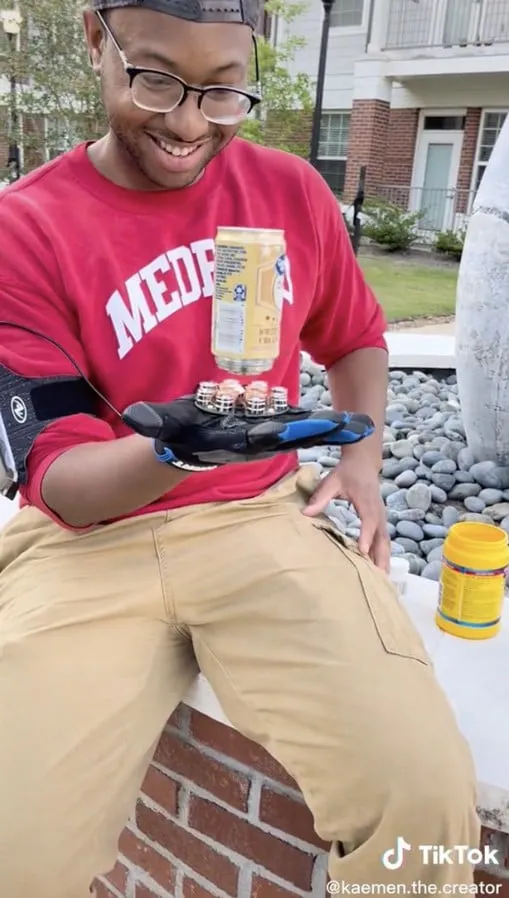
For a hardware brief, show the job that makes the specification matter, then identify the exact product or configuration and a usable purchase destination. Availability, region and price can change the decision. A compelling demonstration of a configuration the audience cannot buy creates a very avoidable dead end.
Give experts access to evidence they can explain
Some technology is difficult to demonstrate on a laptop screen. NeoReach's Intuitive Machines work offers a different route: let a technically credible creator get close enough to explain the system. In the wrap report's 2025/26 chapter, Kaemen the Creator and Chloe Kirk visited HQ to make space communications and infrastructure more understandable to science-curious audiences.
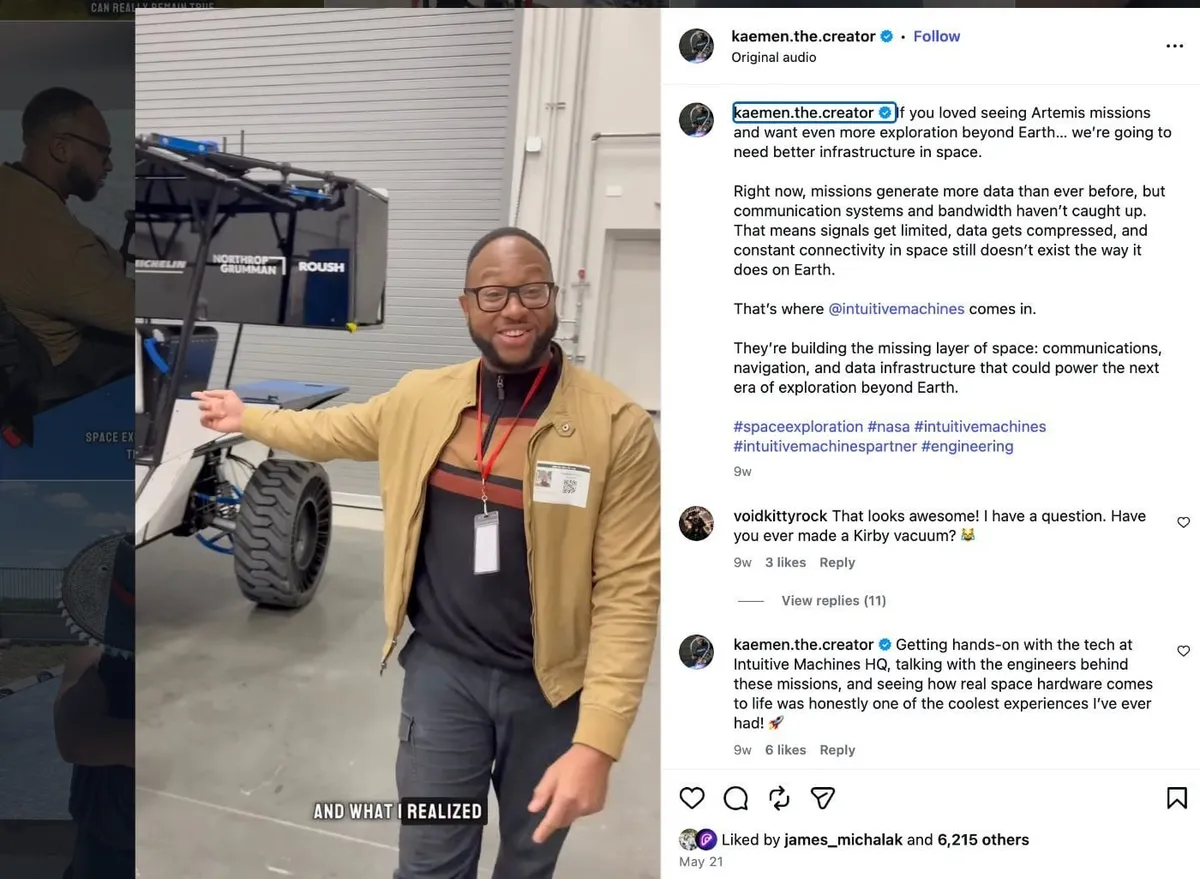
Kaemen the Creator at Intuitive Machines HQ. Access to the hardware gives the explanation a visible reference point.
The chapter reports 2M+ impressions. That measures delivery; it does not establish improved understanding or business demand. The transferable tactic is access: the creator can show hardware, ask questions and connect an abstract infrastructure problem to something visible.
- 2M+impressions reported in the Intuitive Machines wrap report chapter
For a complex tech brand, decide what the audience must understand before planning the visit. Arrange the relevant engineer, environment or demonstration. Agree what can be filmed and which claims need technical review. Preserve the creator's ability to ask a sensible follow-up question; a factory tour with no useful explanation is still just a tour.
Judge this assignment according to its purpose. If understanding is the objective, use a suitable comprehension or brand study. If the goal is professional evaluation, provide a relevant next resource and record the resulting inquiries. Do not force a public education campaign into an immediate-sales claim because the reporting template has a revenue box.
Use paid distribution to test useful demand
TikTok's historical account of Photomyne's creator campaign describes 12 organic posts from 10 creators, with selected videos promoted as Spark Ads. The platform reports a 27.5% app-install conversion rate and a 50% reduction in CPA. The public account does not give a sufficiently detailed comparison window or baseline to treat those numbers as a forecast for another brand.
- 12organic posts from 10 creators
- 27.5%app-install conversion rate reported by the platform
- 50%reduction in CPA reported by the platform
The operating idea is useful: commission content, examine the response, then test selected assets with paid distribution. The organic response helps identify candidates; it does not tell you which creative will acquire valuable users when shown to a different audience with a media budget behind it.
Agree paid usage rights before production, including duration, edits and the accounts that may run the content. Keep creator production and media spend visible. When comparing assets, hold the audience, offer, destination and measurement window as consistent as practical. Change one important variable at a time when you want to explain the result.
A LOW SIGNUP COST CAN HIDE EXPENSIVE ADOPTION
Consider an illustrative program costing $4,000 in total and generating 1,000 signups. The signup cost is $4 in every scenario below. If 20% complete the first useful product task, the cost per activated user is $20. At 60%, it is $6.67. The difference comes from what happens after signup, with both cost and signup volume held fixed.
Show data
Cost per activated user | |
|---|---|
20% (200 activated users) | 20 |
40% (400 activated users) | 10 |
60% (600 activated users) | 6.67 |
Illustrative planning assumptions. Define activation as the product task that demonstrates useful first use.
This is a planning calculation, not a NeoReach benchmark. Define activation as a meaningful product event: a completed integration, a report created and shared, or another task agreed with the product team. Opening an account is not automatically evidence that the user received value.
Work backward from your economics. In the illustration, a $10 limit per activated user requires 400 activations from the same $4,000 program. If the campaign produces inexpensive signups but few successful users, inspect the promise, destination and onboarding before buying more of the same traffic. More budget can make that problem larger without making it clearer.
Activation still sits short of paid acquisition and retention. Continue tracking those outcomes where the business model requires them. Credited referrals are useful for payment and reporting; estimating additional customers caused by a campaign requires a suitable comparison, such as a carefully designed holdout. Keep those questions separate.
Scale the operation before growing the roster
Canva's historical partnership case study with impact.com reports approximately 9,000 partnerships in the first six months after its September 2019 program launch, with partnership-channel revenue doubling month over month during that period. The network included creators, publishers and B2B integrations. It was broader than influencer marketing, and the source gives no absolute revenue or influencer-only return.
- 9,000approximate partnerships in the first six months after the September 2019 launch
- 2xpartnership-channel revenue doubling month over month during that period
The useful lesson is the infrastructure behind the relationships: onboarding, contracts, tracking and payments. When those processes cannot handle the roster, a larger roster creates more unfinished work. Before expanding, check whether your team can grant product access, answer questions, approve accurate content, reconcile results and pay people on time.
FYXER RECRUITED ADVOCATES FROM ITS OWN CUSTOMERS
In a 2025 interview, Fyxer AI CEO Richard Hollingsworth described checking new customers' LinkedIn followings, resolving their product problems and then asking happy users to share their experience. Trust mattered: the email assistant required access to their inboxes. He described LinkedIn inbound, word of mouth and sales working together; the account does not isolate creator-attributed revenue.
Fyxer's affiliate program gives partners free product access before promotion, plus a referral code and tracking link. Its stated audiences include productivity creators, sales and recruiting educators, and newsletters for client-facing professionals. The program connects product experience with a measurable referral route; the page supplies no achieved conversion rate.
Apply the sequence to your own customer base. Find people who use the product successfully and explain their work to the right audience. Resolve their friction before asking for content, agree any compensation and disclosure, then track referred users through meaningful use. A person with an audience is a candidate. A person with an audience and a credible product experience gives you something to work with.
Make the next budget decision part of the brief
A useful pilot answers one unresolved commercial question. Choose a specific audience and task, commission a small set of suitable creators and make the next action measurable. Use existing campaign performance and product economics to set the decision threshold. Borrow the strategy from a success story; do not borrow its outcome as your forecast.
Use the result to choose the next test
What you observe | What to investigate | Next investment decision |
|---|---|---|
Attention, few relevant visits | Whether the promise attracts the intended user; whether the link and offer are clear. | Revise the hook or action route before extending distribution. |
Signups, little successful use | Mismatch between the demonstration, access requirements and onboarding. | Repair the handoff and retest before scaling acquisition. |
Successful use, weak paid adoption | Fit, price, purchase authority and the value of the paid plan. | Test the commercial offer or audience; do not assume the creator is the problem. |
Useful customers at acceptable cost | Whether results hold with additional spend and other suitable creators. | Expand in steps while monitoring customer quality and concentration. |
Diagnostic hypotheses, not automatic explanations. Check tracking and allow the outcome enough time to occur.
Write down the evaluation window and the person who owns each measure. Include fees, production, rights, media and other agreed program costs. Preserve results by creator and placement so one strong contributor cannot hide several weak ones. For longer buying cycles, distinguish the early decision you can make from the revenue outcome you still need to observe.
Before publication, run the journey from a fresh account or device. Check the disclosure, product claim, destination, access requirements and final event. Then launch with a clear question: what result would earn the next investment, and what would make you change the plan? That is a much better brief than “let's go viral.”
CTA: Build a tech creator strategy with NeoReach.