
What brands have announced, how creators fit the plan, and the acquisition cost assumptions worth testing before November 27.
THE ICONIC is giving Two Broke Chicks a newsroom for Black Friday. Sally McMullen and Alexandra Hourigan will turn shopping advice into a weekly shoppable YouTube show, starting November 6.
The Hack Friday desk sits inside the retailer’s Sydney office, with access to its buying, product and sales teams. The job is to help people decide what deserves a place in the basket. That is a more interesting creator brief than another list of discount codes.
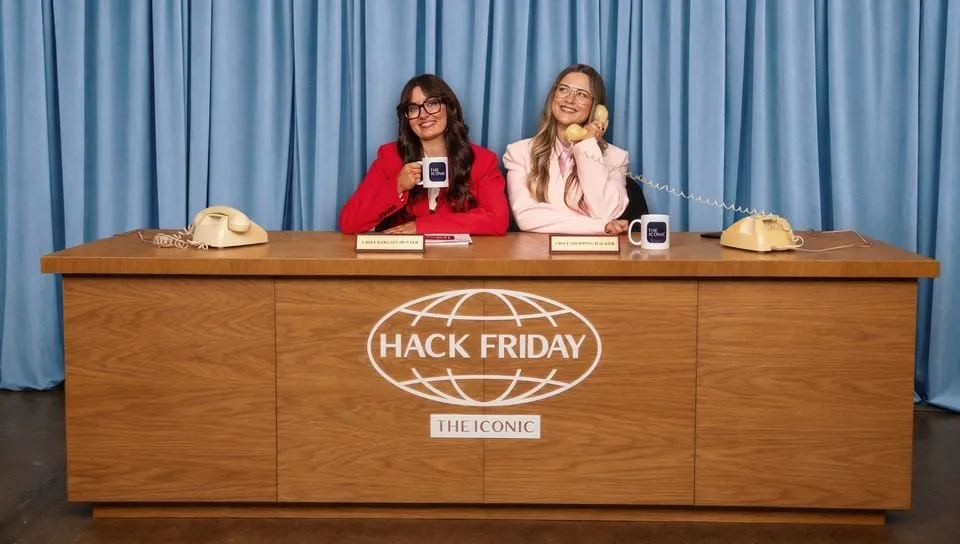
Campaign creative from THE ICONIC and Emotive, via LBB. The announced show begins November 6, 2026.
The strongest brief gives shoppers something to verify
Black Friday falls on November 27, 2026, with Cyber Monday on November 30. The campaign calendar is already busy. Brands are announcing creator shows, sales incentives, staged offers and live shopping programs across several markets. The useful question for an influencer lead is which of those ideas addresses a buying problem your team can actually solve.
BCG’s study published November 4 found that clear comparisons between regular and discounted prices earned a net trust score of 58 percentage points. Influencer recommendations scored 3. The September survey covered 10,220 consumers across ten markets. The measure concerns trust in a promotional deal, rather than creators’ overall influence on purchases.
- 58Net trust score (percentage points) for clear comparisons between regular and discounted prices
- 3Net trust score (percentage points) for influencer recommendations
- 10,220Consumers surveyed across ten markets in September

Show data
Net trust score | |
|---|---|
Retailer reputation | 65 |
Money-back or free-return policy | 65 |
Verified purchase reviews | 59 |
Price comparison | 58 |
Influencer recommendations | 3 |
Give creators a practical assignment. Demonstrate the product, explain which variant the offer covers and help viewers check whether the saving is worthwhile.
The examples below cover announced 2026 plans, including one broader holiday creator campaign that coincides with a confirmed Black Friday calendar. Their commercial results are still unknown. The suggested applications and CAC tests are NeoReach’s analysis of those plans.
Make creators your shopping editors
THE ICONIC’s Hack Friday program combines the weekly show with a hub for product edits, shopping guides and offers. The wider content plan includes guest contributors and internal specialists, distributed across social and owned channels. It is an Australia and New Zealand retail campaign with a clear editorial format.
The idea to borrow is a recurring service with a buying destination attached. For a homeware retailer, that could be a creator helping viewers furnish a small room within a stated budget. For beauty, it might be a routine built around one specific need. The creator explains the selection, while the destination preserves the same products, variants and prices.
Give the presenter access to someone who can answer the awkward questions. Why is this model discounted? Which accessory is missing? Will it arrive before the gifting occasion? Those details make the content useful and give the ecommerce team a manageable list of facts to maintain.
You can test a modest version with an existing partner and one curated product page. Ask the creator to answer a handful of repeated customer questions, then produce short cuts from the same approved material for placements covered by your agreement. Track new-customer conversion from the curated page and the total cost of producing and distributing the series.
A repeatable format might spread production costs across several useful assets. It only does so if those assets are used and reach relevant shoppers. Price the presenter’s work, editing, rights and updates into the test before declaring the content economical.
Make creator incentives auditable
Meroda’s November 1–30 TikTok Shop campaign includes a Fiat 500 or a cash alternative at one reward tier. Eligibility requires acceptance into its Trybe program and at least 30 new qualifying videos. Each must be posted on TikTok with the required product tag and uploaded to Trybe. Rewards depend on qualifying Trybe-attributed GMV, with only the highest achieved tier payable.
Show data
Cash reward option | |
|---|---|
€10,000 qualifying GMV | 1000 |
€50,000 qualifying GMV | 8000 |
€100,000 qualifying GMV | 15000 |
€250,000 qualifying GMV | 50000 |
The transferable idea is to define the incentive and the accounting rules together. A creator should be able to see which sales qualify, where the numbers come from, when they become final and how payment is claimed. An exciting prize does not resolve a disagreement between two dashboards.
For your own program, model several creator outcomes before approving a reward ladder. Include the cost of product samples, ordinary fees or commissions, paid support and any rights you purchase. A threshold reward creates a jump in cost when the threshold is crossed. Finance should be able to see that jump before the campaign begins.
Also distinguish total attributed sales from first-time buyers. A partner can generate substantial GMV from customers who already shop with you. That may be valuable, but acquisition reporting needs the new-customer count and its corresponding cost. Review returns and code leakage before expanding the incentive.
Finally, check whether the content requirement is workable. Thirty videos require planning, product knowledge and production time. Agree on the work and compensation clearly, and give creators enough information to decide whether participation makes commercial sense for them.
Give each sales wave a different brief
Netshoes has announced a Brazilian Black November campaign led by Rafael Portugal, supported by more than 90 influencers and live commerce. Its calendar begins with 11.11 coupons, moves to ten days of offers from November 12, then reaches Black Friday week. The advertised maximum discounts vary by phase.
Netshoes campaign creative, via Grandes Nomes da Propaganda. Full supplied frame preserved.
A changing offer gives you a reason to change the creator’s job. In an early phase, help shoppers choose a category or shortlist the right product. When the relevant offer opens, show the exact purchase. Later content can answer the questions that appeared under the first posts. This is our suggested sequence, rather than a disclosed Netshoes briefing process.
For a sports retailer, the early brief might compare running shoes by intended use. The next placement could show the discounted model on a real run and link to available sizes. A later answer might explain fit or returns. The story develops because the buying question develops.
Keep one offer record for the creator, ecommerce and media teams. It should contain the eligible products, price, code rules, stock position and approved dates. Assign someone to update it when a phase changes. An excellent video with last week’s coupon is an expensive piece of historical content.
Measure each wave against its job and include the earlier spend in the final acquisition calculation. If warm-up content prepares shoppers to buy later, excluding its cost makes the closing campaign look artificially efficient.
Build livestreams around buying questions
Magalu’s announced Brazilian live program includes 14 hours of content with more than 40 personalities. Programming is scheduled across November 10, 11, 26 and 27, with category specialists and a Black das Blacks event at Galeria Magalu in São Paulo. The plan connects its physical and digital retail activity.
- 14 hoursOf announced Magalu live content
- 40+Personalities in Magalu’s live program
Magalu promotional creative, via Nosso Meio. Planned live hours describe programming volume, not sales performance.
The useful idea is a staffed shopping program. Give a creator a category they can explain, a product worth demonstrating and someone who can answer stock, delivery and offer questions. A live host who must improvise fulfillment policy is doing three jobs and enjoying none of them.
Start your own test with a narrow product range. Collect questions from customer service and earlier posts, then build demonstrations around the unresolved ones. For a kitchen appliance, show setup, cleaning and the quantity it can handle. Let the host repeat the offer clearly for people who join midway through.
Assign separate responsibility for presenting, moderation, product tagging, offer updates and technical production. Prepare a replacement product or destination if the featured item becomes unavailable. Turn useful answers into subsequent clips only where your content agreement allows it.
The potential acquisition benefit comes from resolving uncertainty while a shopper can act. Measure new-customer orders and the complete cost of the session, including hosts, production and traffic bought to bring viewers in. Hours broadcast and simultaneous viewers describe delivery, so keep them beside the commercial measures.
Match creators to a specific shopping mission
Amazon Brazil’s Black dos Sonhos campaign features Tatá Werneck and a planned network of more than 1,000 macro and micro creators during November. A separate shopper promotion runs November 2–30, with a R$1 million prize and weekly product prizes. The prize belongs to the customer promotion.
- 1,000+Macro and micro creators planned for Amazon Brazil’s Black dos Sonhos campaign
- R$1 millionPrize in Amazon Brazil’s separate November 2–30 shopper promotion
A recognizable campaign idea can give a large roster a common identity. Your selection and briefing still need to explain why each creator belongs. Assigning creators by gift mission is one way to test that fit, although Amazon has not disclosed that as its process in this announcement.
A suggested brief for different shopping missions
Shopper question | Creator assignment | Destination |
|---|---|---|
What fits a small home | Demonstrate size, storage and setup | A curated compact-product edit |
What should I buy a beginner | Explain the starter option and necessary extras | An entry-level kit with clear contents |
Which upgrade is worth paying for | Compare the practical difference in use | A comparison page with current prices |
What arrives in time | Explain verified delivery and collection options | The relevant local availability page |
NeoReach briefing examples. These assignments are recommendations, not Amazon’s disclosed creator segmentation.
Give each assignment a distinctive reason to click. A general “my Black Friday favorites” video can leave people browsing the same broad assortment they already saw elsewhere. A clear mission narrows the choice and lets the destination do a specific job.
For acquisition measurement, compare missions using a consistent new-customer definition and cost window. Keep retention or member promotions visible as separate activity where possible. A large roster is an organizational commitment, and overlapping audiences can make its reach smaller than the sum of its follower counts.
Cast separately for entertainment and evaluation
Best Buy’s Open More holiday plan pairs Dude Perfect’s competitive tech content with Marques Brownlee’s gifting recommendations. It also enables creators to tag Best Buy products on TikTok Shop. These are announced holiday collaborations, with individual creator posting dates still undisclosed.
Official Best Buy Open More holiday creative. This is brand campaign art, not a still of the creator collaborations.
The retailer’s separate trading calendar starts early Black Friday deals on November 6 and a ten-day Black Friday event on November 19. That establishes the sale context for its holiday activity.
The idea to test is casting for different consumer decisions. Entertainment can introduce a product through a situation people want to watch. Specialist evaluation can help a shopper decide whether the specification, price and use case fit. Each needs its own brief, even when both work within the same campaign.
For a gaming product, you might brief an entertainer to show a multiplayer experience and a specialist to explain compatibility or setup. Agree on the product truth and offer across both. Let their expertise determine the execution. Asking every creator to read the same script spends money on differences you then remove.
Connect each format to an appropriate buying route. Check the tagged product, variant, delivery promise and current offer from the viewer’s market. A shorter path to checkout is worth testing, but report how many new customers complete it. Reduced friction is a hypothesis until the purchase data supports it.
Connect short videos with live shopping
TikTok Shop’s October 19 Road to Black Friday feature describes three brands preparing for the season. Princess Polly is expanding creator content, short video and LIVE alongside inventory and promotions. Dossier plans seasonal products, giftable bundles, creator storytelling and expanded LIVE. SharkNinja’s approach centers on home demonstrations and product questions, with no specific Black Friday roster or schedule disclosed.
TikTok Shop’s Road to Black Friday documentary artwork. The feature discusses the three brands’ seasonal preparations.
The platform’s US campaign for Black Friday and Cyber Monday runs November 11–30. Its announcement includes LIVE shopping and gift bundles.
For your own campaign, connect formats around the same buying question. A short video can reveal an issue worth exploring. The live session can answer follow-up questions, and a later clip can preserve the most useful answer. Keep the product and offer consistent so the viewer does not have to reconstruct the journey.
A fragrance brand, for example, could use a creator’s occasion-based recommendation to invite shoppers into a comparison session. A follow-up clip could explain the difference between two scents repeatedly mentioned in comments. This gives the next asset a reason to exist and the host a specific question to resolve.
Budget the handoffs. Product samples must arrive, the creator needs genuine experience, inventory must support the promoted bundle and the team needs permission to reuse content. Connecting formats can increase production efficiency when the assets are useful. Simply adding more placements also adds more cost.
Higher CPM makes the response rate matter more
Emplifi’s October 15 report puts US Meta CPM at $6.96 in Q3 2026, up from $6.06 a year earlier. Its reported click-through rate rose from 1.58% to 2.05%. These are vendor-panel medians from the quarter before Black Friday, with the paid-account count undisclosed.
- $6.96US Meta CPM in Q3 2026, up from $6.06 a year earlier
- 2.05%US Meta click-through rate in Q3 2026, up from 1.58%
Show data
CPM | |
|---|---|
Q3 2025 | 6.06 |
Q3 2026 | 6.96 |
Show data
Click-through rate | |
|---|---|
Q3 2025 | 1.58 |
Q3 2026 | 2.05 |
The lesson for planning is to examine impression cost, click response and new-customer conversion together. Creator ads still compete in the paid auction. Better creative may earn a more useful response, but a creator identity does not exempt the placement from the media bill.
Sprout Social’s 2026 holiday survey adds a briefing clue. Thirty percent of respondents named company-or-influencer promo codes as something that would make them more likely to buy, while 28% named brand posts showing products in action. The August survey covered 2,286 social users in the US, UK and Australia. Those are stated preferences, rather than measured sales effects.
- 30%Named company-or-influencer promo codes as something that would make them more likely to buy
- 28%Named brand posts showing products in action
- 2,286Social users surveyed in the US, UK and Australia in August
Test a creator asset against the current alternative using the same product, offer, audience definition and attribution window where possible. Look beyond CTR to new-customer conversion, returns and contribution. An entertaining video that attracts the wrong visitors can increase clicks while making acquisition less efficient.
Set a review point with the media and analytics teams. If delivery is healthy but shoppers abandon the product page, inspect the offer and destination before commissioning another ten videos. The cheapest fix may sit after the click.
What would need to change to lower CAC
The scenario below isolates the arithmetic. Both options buy 100,000 impressions at an assumed $18 CPM. The existing asset incurs $1,800 in media spend. The creator test adds $600 in incremental creative cost. These figures are illustrative inputs, not a market rate card or a forecast for any brand in this report.
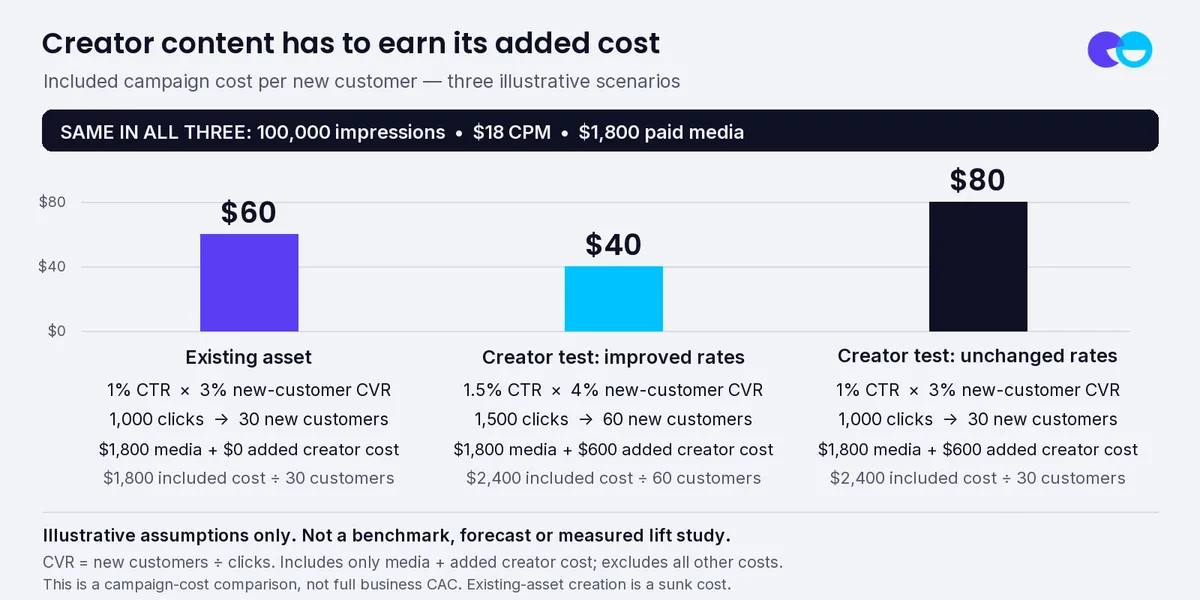
NeoReach illustrative calculation: creator production only improves the included cost per new customer if enough additional customers offset its cost. All scenarios hold impressions and CPM constant. The comparison includes paid media and incremental creator cost; it excludes all other costs and treats existing creative as sunk. Assumptions, not a benchmark, forecast or lift study.
At a 1% CTR and 3% new-customer conversion rate from clicks, the existing asset produces 30 customers and a $60 acquisition cost on the included spend. If the creator test reaches a 1.5% CTR and 4% conversion rate, it produces 60 customers. Its $2,400 included cost then works out to $40 each.
- $60Illustrative cost per new customer, existing asset (30 customers)
- $40Illustrative cost per new customer, creator test with improved response (60 customers)
- $80Illustrative cost per new customer, creator test with unchanged response (30 customers)
The third scenario matters. If response stays unchanged, the creator version still produces 30 customers, and the extra fee raises the included acquisition cost to $80. Under these assumptions, it needs 40 customers to match the existing $60 cost. That is the hurdle the test must clear, before considering other costs or profit.
Use the same discipline for the ideas above. A show can distribute production cost across useful episodes. A live session can answer objections. An incentive can make some costs conditional on validated sales. Earlier content can prepare an audience. Each mechanism has a cost and an assumption that needs to be checked.
For your actual campaign CAC, include the costs your team agrees belong in acquisition, such as creator fees, production, usage rights, media, commission and allocated campaign operations. Deduplicate first-time buyers and state the attribution window. If you use creator codes, examine existing-customer purchases and returns before treating their revenue as acquisition.
Judge CAC alongside contribution after the discount, product costs, fulfillment, fees and returns. A lower acquisition cost can coexist with a weaker margin. Use observed repeat buying if you intend to recover the investment later, and give finance a defined payback period.
Finally, attribution assigns credit. A credible lift test estimates additional customers. Where feasible, plan that comparison before launch and specify which activity it isolates. A strong creator code report can justify further investigation without proving the campaign caused every recorded purchase.
Use the announced dates to plan your next move
Selected dates already announced for 2026
Date | Program | What is scheduled |
|---|---|---|
November 1–30 | Meroda | Creator reward campaign |
November 6 | THE ICONIC | First weekly shoppable episode |
November 6 | Best Buy | Early Black Friday deals begin |
November 10 and 11 | Magalu | Initial live programming |
November 11–30 | TikTok Shop US | Black Friday and Cyber Monday campaign |
November 12 | Netshoes | Second offer phase begins |
November 19 | Best Buy | Ten-day Black Friday event begins |
November 26 and 27 | Magalu | Black das Blacks programming |
Dates describe the named programs and markets. They are not universal creator posting deadlines. Brand details and links appear in the relevant sections.
For a team planning from November 5, choose a manageable format and a partner who already understands the product. Give the campaign one buying question to answer, one confirmed offer and a destination that can fulfill the promise. Match the remaining production time to the work you can approve properly.
Before filming. Confirm stock, final price, eligibility, delivery, creator compensation and usage permissions. Decide which product claims need evidence and who approves them.
Before buying traffic. Test the actual link or product tag, checkout, discount and reporting. Give someone authority to pause affected placements when stock or the offer changes.
Before scaling. Reconcile cost and first-time customers. Check the quality of the orders and the margin left after the promotion. Expand the activity only when the evidence supports the next spend.
The most useful idea may be a small part of a larger brand’s plan. Borrow the shopping-editor role, the clear incentive rules or the product specialist in a live session. Then put a number against what your version must achieve to earn its place in the budget.