Choose the right payment model, define the result, and build a creator program your finance team can actually evaluate.
A creator delivers every asset. Paid media hits its traffic target. Sales asks where the orders are. The wrap deck somehow says everyone won.
That is a plausible outcome when “performance” means something different to every team in the room. Before you negotiate a commission rate, agree on the result you want, the work you are buying and the evidence that will trigger payment.
Performance-based influencer marketing ties some or all creator compensation to an agreed, measurable result. That might be a qualified lead, a validated purchase or a defined delivery metric. A hybrid agreement combines a fixed fee with an outcome-linked payment. A commission-only agreement puts the compensation entirely against the agreed result.
The argument in one sentence. Define the payment structure, the payable result and the verification rules separately—then make the brief, landing experience and reporting support the same goal.
Separate the payment model from the performance metric
There are three decisions to settle. Mixing them together is how a conversation about creator fees ends up becoming an argument about attribution halfway through the campaign.
Choose how compensation is structured

Structure | How payment works | What to resolve |
|---|---|---|
Fixed fee | An agreed amount for specified deliverables and rights. | Scope, acceptance criteria, usage and payment schedule. Performance can still be evaluated against a business objective. |
Outcome-only | Payment depends entirely on eligible results, such as a commission on validated sales. | The payable event, tracking, exclusions and the work the creator is willing to fund before a result occurs. |
Hybrid | A fixed fee plus a variable amount tied to eligible results. | Which work the base covers and exactly how commissions or performance bonuses are calculated. |
NeoReach planning framework. Fixed fee is included as the comparison; outcome-only and hybrid structures link compensation to results. These are definitions, not measured rankings.
A milestone bonus is one way to structure the variable part of a hybrid deal. Tiered commission changes the payout rate as agreed thresholds are met. Neither needs its own grand theory. Both need terms that two people can calculate the same way.
Name the event that earns the variable payment
Delivery: an eligible view or impression. Traffic: an eligible click. Lead: a signup or enquiry meeting agreed qualification rules. Sale: a completed purchase meeting the agreement’s requirements. These events sit at different distances from revenue, so choose the one that fits the business objective and the data you can verify.
Paying for clicks creates an incentive to generate eligible clicks. If your commercial target is new customers, the plan also needs a way to assess what happens after the click. Otherwise, you have given the creator one scoreboard and the budget owner another.
Decide whose record settles the result
Specify the reporting system, attribution window, eligible audience or geography, treatment of returns, and rules for duplicate claims. Agree what happens when a link and a code identify different creators. State whether paid amplification can generate commissionable orders. Set a validation deadline and payout date, including how long returns can affect the count. These are working decisions for your agreement, not details to improvise when the invoice arrives.
77% of creators cite time and effort when setting rates
In NeoReach’s 2026 creator research, 77% cited time and effort as a pricing factor, followed by follower count at 52% and engagement rate at 48%. The overall study included 539 creators; item-specific response counts and geography were not disclosed.
- 77%Cited time and effort as a pricing factor
- 52%Cited follower count
- 48%Cited engagement rate
- 539Creators in the overall study
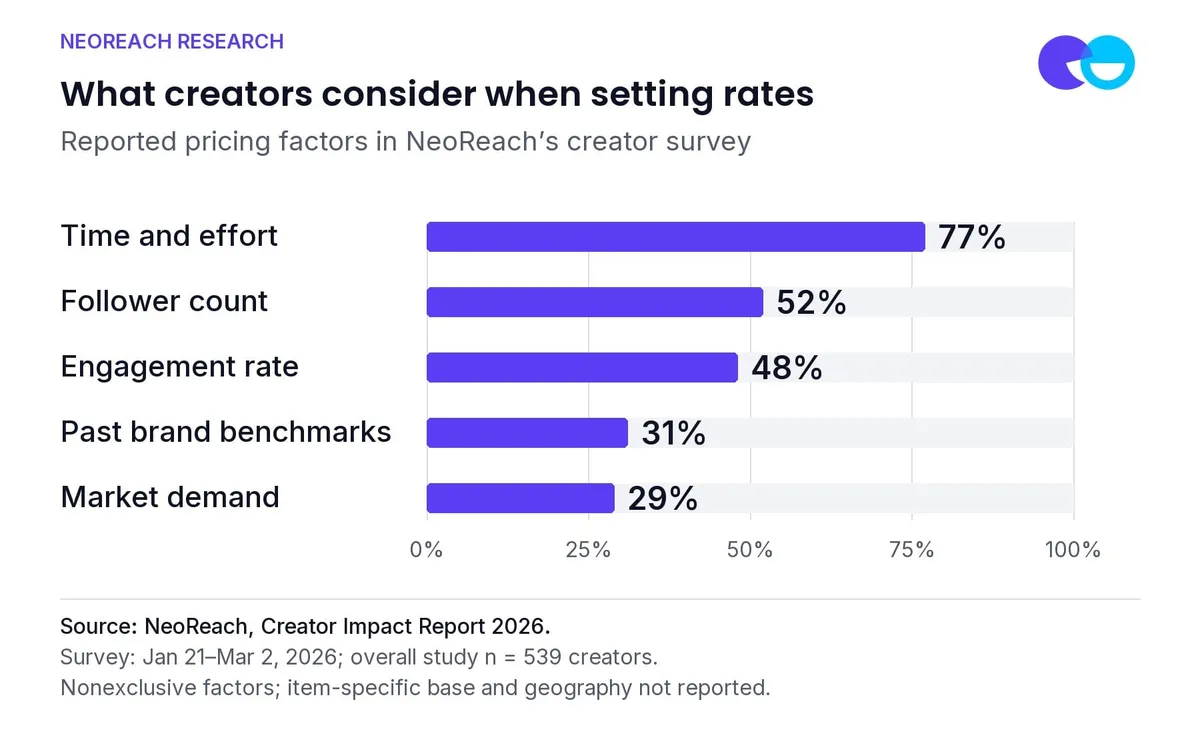
Time and effort was the most frequently cited of these pricing factors. Percentages describe pricing inputs, not creator fees or payment-model preferences.
That finding gives you a useful place to start a negotiation: the work. Product testing, scripting, filming, revisions and additional versions all belong in the scope. Paid usage, exclusivity and extra deliverables need their own discussion. Calling the deal “performance-based” does not remove those requirements.
For a commissioned campaign with substantial production work, our recommendation is to consider a fixed production fee with a clearly defined performance upside. Price the work you need, then negotiate the additional reward for eligible outcomes. This is a planning recommendation; the survey did not test whether hybrid deals outperform other structures.
Outcome-only can be an option when both sides actively want an affiliate arrangement and accept the result definition, economics and workload. Give the creator enough information to judge it. A request for multiple concepts, several approval rounds and broad usage rights deserves a more considered offer than “there’s upside.”
Keep the creative brief focused, too. Specify the product benefit, supporting evidence and required information. Let the creator decide how to make the explanation watchable. A Reel should not have to carry the entire marketing plan on its back.
Similar paid exposure produced very different click results
Two NeoReach campaign recaps for Amazon Publishing from November 2023 show why the metric matters. Paid TikTok support for It’s a Date (Again) reported 506,753 impressions and 6,279 clicks. Mindy’s Book Studio reported 498,274 paid impressions and 249 paid clicks.
- 506,753It’s a Date (Again) paid impressions
- 6,279It’s a Date (Again) paid clicks
- 498,274Mindy’s Book Studio paid impressions
- 249Mindy’s Book Studio paid clicks
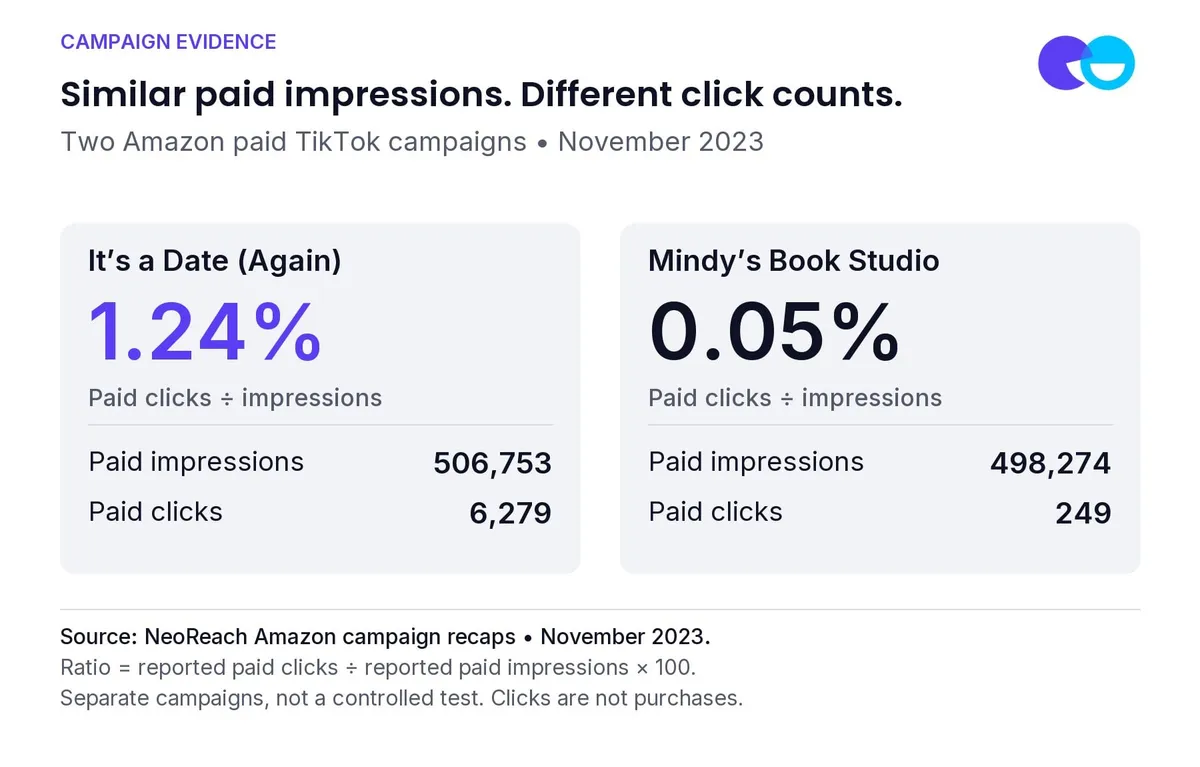
The paid click-to-impression ratios are recalculated from each campaign's reported counts. They describe response to different executions, not a causal test or a sales conversion rate.
The paid click-to-impression ratios work out to 1.24% and 0.05%, respectively. The two campaigns received a similar volume of paid impressions; their reported traffic outcomes were far apart. The records do not isolate which differences in audience, creative, offer or delivery caused that gap.
- 1.24%It’s a Date (Again) paid clicks ÷ impressions
- 0.05%Mindy’s Book Studio paid clicks ÷ impressions
For your next campaign, use this as a reason to brief and measure the intended action. Review what the audience is being invited to do, where the link appears and what happens at the destination. If clicks are payable, define the eligible click. If purchases are payable, the evidence has to continue through to the order.
Neither recap supplies a purchase total for this comparison. These are traffic results, with ratios recalculated from the reported counts. The case records also do not establish that these creators were paid per click. Campaign outcomes and creator compensation are separate facts.
Give every placement a clear job
NeoReach’s BuzzGuru free-trial campaign makes the placement question especially concrete. One Instagram Story by Brock Johnson supplied 413 of the campaign’s 441 reported clicks—93.7%. The Story reported reach of 3,869. His Reel reported reach of 279,000 and zero clicks.
- 413Clicks from Brock Johnson’s Instagram Story, of 441 reported
- 93.7%Share of reported campaign clicks
- 3,869Reported Story reach
- 279,000Reported Reel reach, with zero clicks
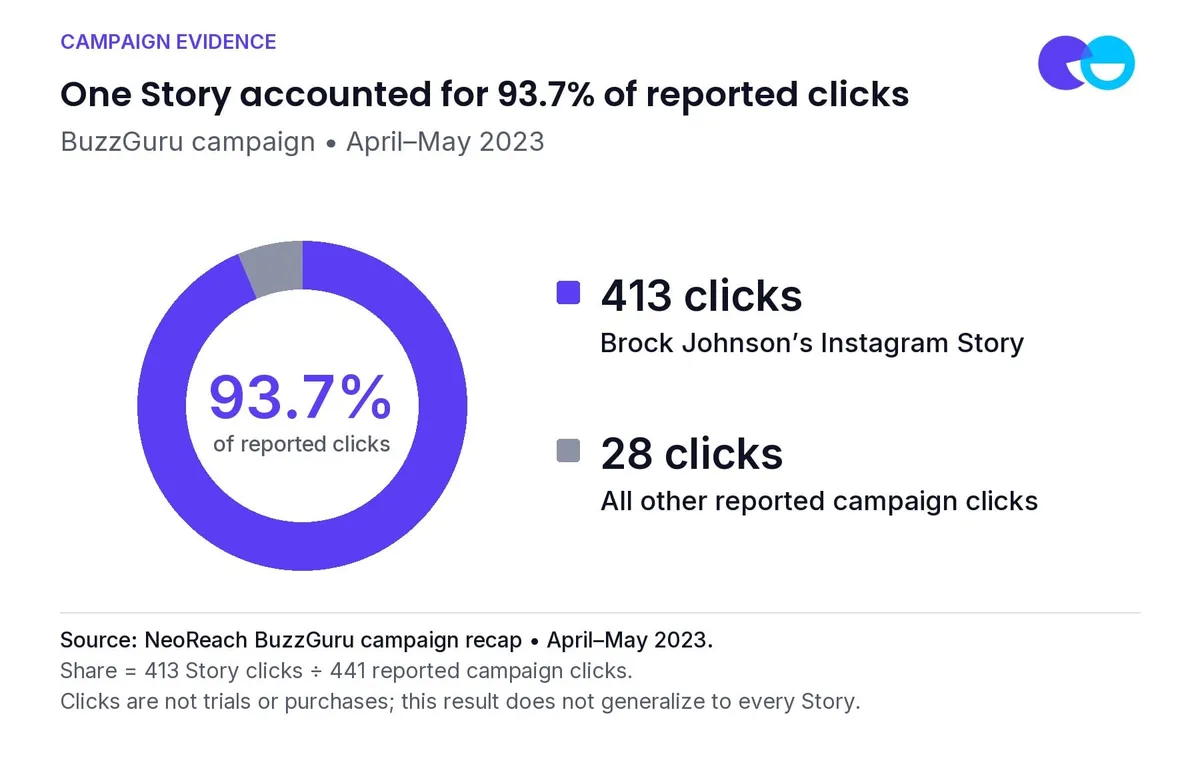
Brock's Story generated 413 of the 441 clicks reported for this campaign. The concentration shows why placement-level reporting matters; it does not establish trial starts or purchases.
A reach-only review would tell you very little about where that campaign’s tracked traffic came from. The practical response is to commission a route to action alongside the explanation: a visible invitation, a usable link and a destination that delivers what the creator promised.
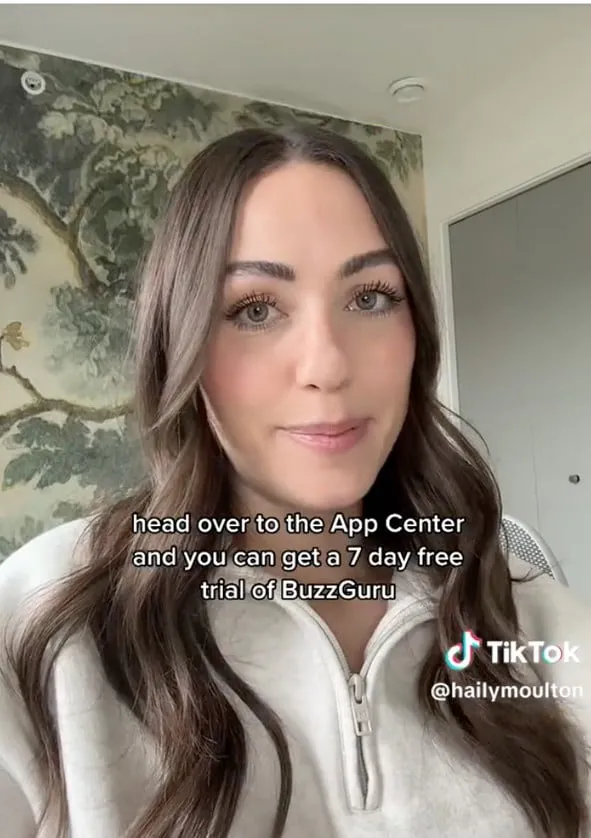
In the TikTok execution shown here, the creator tells viewers where to go and what they can try. That is a concrete next step to build into a brief. The click result above belongs to a different execution: Brock’s Instagram Story.
This was not a controlled Reel-versus-Story test. The placements had different click routes and exposure, and clicks do not establish trial signups. Use the case to sharpen your deliverables and tracking plan; test the combination that fits your own audience and product.
Price the whole program before you promise a return
A commission percentage tells you what one part of the arrangement costs. Your budget also has to account for production, paid distribution, usage rights, fulfillment, management and measurement. Include each cost once, even when several sit inside a single fee.
The USIMS campaign provides a useful example of the distinction. Its 2025 recap records both creator-led activity and paid media. A table of five selected paid creatives lists spend and orders, allowing a paid-media cost per reported order to be recalculated for each.
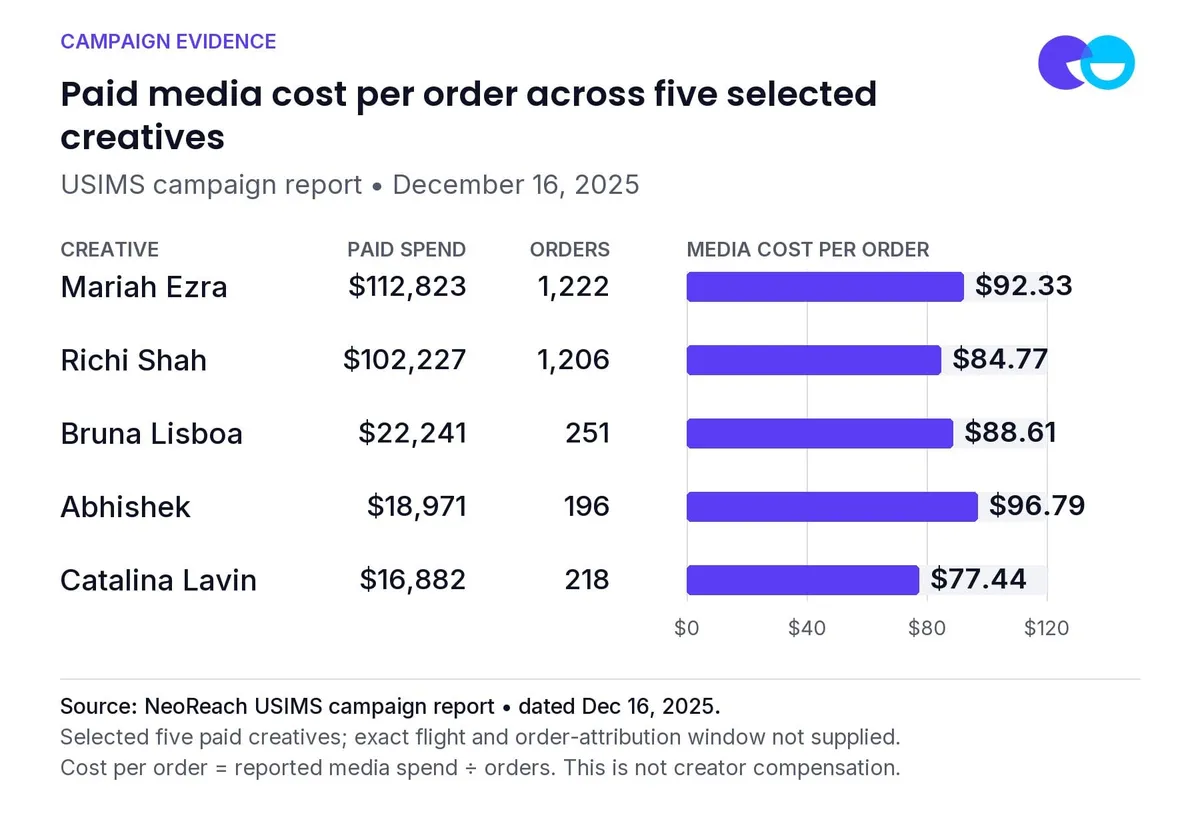
Recalculated media cost per order for the five creatives selected in the USIMS report. The subset is not representative of every creator or the full campaign, and the exact attribution window is unavailable.
Across those five selected creatives, that measure ranges from $77.44 to $96.79 per reported order. It answers a paid-media efficiency question. The table reports paid-media spend and does not provide the creator fees and other costs needed to establish a full-program total. Those values cannot stand in for the full cost of acquiring a customer.
- $77.44Lowest recalculated media cost per reported order
- $96.79Highest recalculated media cost per reported order
The same recap says an AWIN affiliate program was built and launched. That documents an affiliate setup; it does not tell us the creators’ commission rates or establish that the paid-media orders in this chart came through that affiliate program. Keep the systems and their results separate until the underlying records connect them.
Make the economics usable. Add up the full program spend, counting each cost once. Divide it by validated, attributed orders, counting each order once. If acquisition is the goal, use verified new customers instead. Ask finance to judge that cost against margin, returns and the approved payback assumptions.
A smaller acquisition cost is only useful when you know what was included. Present media-only and full-program costs with explicit labels. Give finance a number it can use without first having to reverse-engineer the slide.
Agree on what counts as a sale before launch
The InBody program paired creator content with paid distribution. Its 2024 wrap reported 1,597 attributed sales over ten months. That is a more commercially relevant outcome than an impression count when the objective is sales.
- 1,597Attributed sales reported in the 2024 InBody wrap
- 10Months covered by the reported attributed sales

It also comes with a measurement question. The wrap’s aggregate was not reconciled to an order-level export in the supplied materials, and supporting records mix store sales with modeled attributable sales. We retain the figure as a reported attribution claim. It does not establish 1,597 incremental purchases or 1,597 orders eligible for creator commission.
For a performance-based agreement, the order ledger needs to do more than look convincing in the wrap deck. It should make the payable result inspectable: the order identifier, relevant creator or code, qualifying date, value and validation status, with appropriate data access for the people who need to resolve it.
Four questions your reporting should answer
Question | Evidence to use |
|---|---|
Did the content run? | Approved and published deliverables, plus platform-defined delivery metrics. |
Did people act? | Defined clicks, site actions, qualified leads or purchases, with a stated reporting window. |
What payment is due? | Validated eligible events under the agreement, after applicable exclusions and duplicate checks. |
What additional business did the campaign create? | An appropriate holdout or credible comparison designed to estimate incremental impact. |
NeoReach measurement framework. These are separate questions, not a measured conversion funnel or a promise that every campaign can answer all four.
Attribution assigns credit under a set of rules. Incrementality asks what changed because of the activity. Your creator agreement needs a clear rule for payment; your investment decision may require stronger evidence about additional demand. Plan that distinction before the campaign, especially when deciding whether to expand it.
Build a program both sides can actually run
Once the definitions are clear, put them into one operating brief. The document should be useful to the influencer lead, creator, media buyer, ecommerce owner and person approving payment. Nobody should need three spreadsheets and a diplomatic incident to understand their next step.
Set one primary objective. Name the audience, the action and the result that would justify another investment.
Specify the work and the deal. List deliverables, usage, revisions, fixed compensation and the rules for any variable payment.
Walk the buying journey. Check the product explanation, link, offer, availability and destination on a phone before launch.
Test the tracking and validation. Confirm how an eligible result appears, how duplicates are handled and who resolves a disputed count.
Assign owners and review dates. Give approvals, reporting, creator questions and payments a named point of contact.
Choose the next test deliberately. Compare a meaningful creative, placement or offer decision, document differences in delivery, and keep the weak results in the record.
The relationship deserves the same operational care as the dashboard. NeoReach’s creator report states that 91% cited smooth communication in the context of partnering with a brand again. That is a reported partnership factor, not a renewal rate. A clear explanation of how a payment was calculated is one practical place to put the finding to work.
- 91%Cited smooth communication in the context of partnering with a brand again
Use the first cycle to learn whether the offer, content, purchase experience and measurement work together. Expand when the evidence and economics support it. If they do not, identify the specific failure before asking more creators to repeat the same setup.
Performance-based influencer marketing gives you a way to connect compensation to results. Your team still has to build the conditions that make those results worth paying for.
CTA: Request a creator strategy briefing for your brand.
About the evidence
This article uses NeoReach’s campaign records and the creator survey reported in the Creator Impact Report 2026. The creator study included 539 participants, with fieldwork from January 21 to March 2, 2026; geography and item-specific bases were not disclosed. Survey responses describe reported considerations and preferences.
Campaign figures are source-reported and retain their original scope. The examples span 2023–2025 and do not form a pooled benchmark. The USIMS chart includes five creatives selected in its recap, with exact attribution dates unspecified. Paid click ratios and cost-per-order figures were recalculated from displayed counts and spend where printed ratios did not reconcile. Creator payment terms are not consistently documented in the campaign records. The compensation taxonomy, operating brief and decision rules are NeoReach recommendations.